
Legacy
I didn’t expect to start writing this on Thanksgiving Day—in the passenger seat of my parents’ car, somewhere between the East Bay and Marin, on our way to dinner with our cousins. But maybe it’s fitting. Holidays have a way of bringing up feelings about home, family, and what remains when the people who shaped us are no longer here.
This is our second Thanksgiving without my grandmother—and without her 99 years of stories, routines, rituals, and a fierce independence that quietly taught me how to move through the world. For 20 years we gathered with her in Pacific Grove, where she lived in a small retirement community. The staff there weren’t just caregivers; they were family. They loved her. And she loved them.
Those Thanksgivings were warm and hilarious and familiar: dinner in the dining room, endless political debates in her little apartment afterward, sunset cocktails, the easy sharing of jokes, stories, and love.
Now the tradition looks different. Still good, still warm, still us—just… changed. It was while celebrating her 99th birthday that this idea of legacy started forming for me. What remains after the rituals shift? After the matriarch is gone? After the familiar place no longer anchors the familiar people?
And strangely—or maybe not strangely at all—that’s exactly where my mind returned as I began to write about Machu Picchu. Because legacy is what Machu Picchu is really about. And legacy, whether we want it to or not, is also what each of us is building every day—through the choices we make, the paths we take, and the places in ourselves we refuse to shrink anymore.
The Legacy We Come Looking For
People speak about Machu Picchu with reverence.
“It’s on my bucket list.”
“It’s been my dream forever.”
“You’re going to feel the magic.”
And maybe that’s why I expected to feel something transcendent when I finally reached it: a lift in my chest, a spiritual pull, the weight of standing where an empire once breathed.
But the truth? I didn’t feel magic. I felt… crowded.
Stepped around, stepped in front of, pushed aside so someone else could get the perfect angle for their photo. Pressed down narrow stone paths by a group close behind me—so close I kept having to move before I could linger, before I could really look at the extraordinary laid out before me. And to be fair, I’m sure I stepped into someone else’s frame, too. We were all just trying to capture something fleeting before the clouds closed in again.
My senses—usually how I anchor myself in a place—were overrun. I don’t remember the smell of the earth. I don’t remember the sound of the wind. I don’t remember how the air felt on my skin. I remember noise. And the pressure to keep moving.
And in that overstimulation—something in me went quiet. Not the spiritual quiet I had hoped for. A different kind. A muted kind.
One that left me wondering… Did I miss Machu Picchu’s spirit because I was too busy documenting it? Too busy keeping up? Too busy trying not to be in the way?
What Remains When Presence Slips Through Your Fingers
Legacy is what lingers when everything else falls away.
For Machu Picchu, it’s in the engineering genius—terraces, aqueducts, and earthquake-resistant walls carved with purpose and precision. It’s the ingenuity of the Incan people who built a sanctuary that blends seamlessly into the natural environment.
For me, legacy isn’t what I felt in the moment. It’s what surfaced after—in the photo editing, in the quiet of my San Francisco apartment with my cat curled in my lap, in the looking back. Despite the crowds, the rushing, the noise… the beauty was still there. I see it now, in the photos… The terraces dissolving into cloud. The mountains rising like guardians. The valleys unfolding in layered greens and stone. In some ways, the photos carried the spirit I couldn’t access while I was standing there.
Maybe that’s part of the lesson… Some places aren’t felt in the moment. Some moments don’t reveal themselves until later. Some experiences only make sense in hindsight.
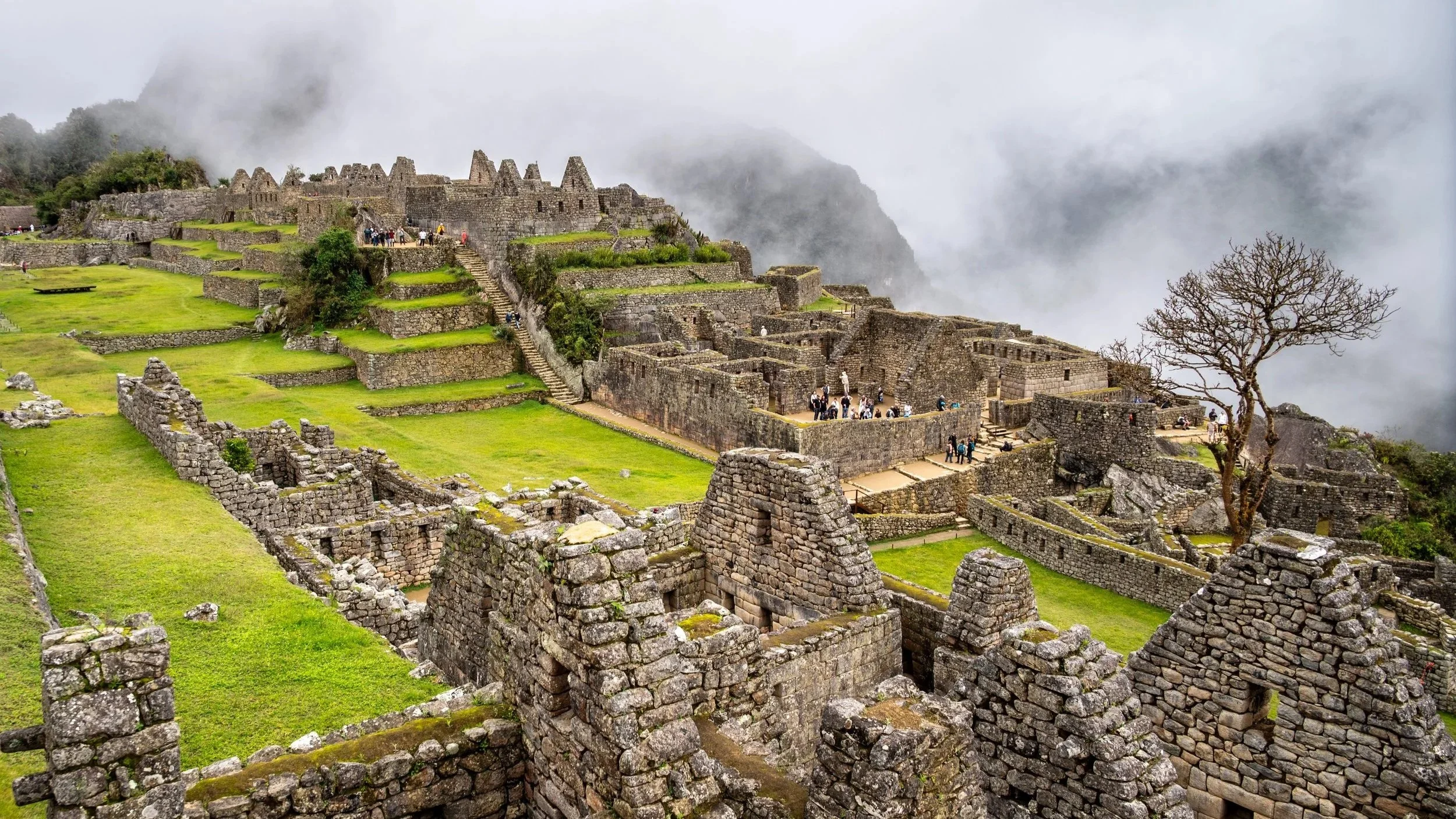
Machu Picchu, Peru
What the Mountain Reflected Back
Here’s the part I didn’t expect to realize… Standing in a place built to outlast centuries—shaped by hands who knew their work would outlive them—I felt something I hadn’t quite named before. I’ve spent years being proud of my independence. Of still traveling when others couldn’t. Of choosing the world even if it meant walking into it alone.
It’s a strength my grandmother modeled so effortlessly—booking tours and seeing the world, traveling with friends (and sometimes me), but refusing to wait for anyone to be ready.
But up there, above the Sacred Valley, something shifted. I didn’t feel lonely. Just… aware.
Aware of how much I’ve carried on my own. Aware that independence has been both my freedom and my armor. Aware that maybe—in this next chapter—I don’t want to do everything alone anymore. For so long, courage meant going alone. Lately I’ve wondered if courage might also mean letting someone walk beside me.
Travel is a mirror. And Machu Picchu—crowded, imperfect, iconic, enduring—reflected back a truth I didn’t know I was ready for.
So What Lingers Now?
I think what lingers is this… Machu Picchu was not what I expected. It did not give me spiritual chills. It did not give me transcendence. It did not give me the clarity some people say it will.
But it did give me something else—a reminder that not every dream arrives the way you expect. Not every wonder feels wondrous in the moment. Not every path is meant to be walked alone. And legacy isn’t what you leave behind—it’s what you carry forward.
The Incas didn’t build Machu Picchu so we could take selfies. They built something meant to endure, to hold meaning, to outlast earthquakes and centuries.
I want to build a life like that. A life of intention. A life of presence. A life I don’t rush through so quickly that I miss the spirit of it entirely.
I’m learning—slowly, repeatedly, imperfectly—that being present is its own kind of legacy. And that the life I’m stepping into now—Spain, teaching, creativity, freedom, maybe even love—deserves that presence. (A lesson that first found me in Urubamba.)
I don’t want to be so busy documenting the journey that I forget to live it.
Happy Birthday, Grandma
Tomorrow would have been my grandmother’s 101st birthday. Maybe that’s why this post needed time—why I needed a little more space to understand what I was really trying to say.
Because she taught me, quietly and consistently, what it looks like to keep moving forward even after life rearranges itself. And the courage she lived by—the curiosity, the ability to wander into the world alone and still feel whole—is the same courage I’m trying to carry now.
Her legacy shows up in the choices I make: to step into the unknown, to follow what lights me up, to build a life I don’t have to shrink inside of.
And I think she’d be smiling at this next chapter—Spain, teaching, creativity, possibility—all of it. She might even be proud of me for choosing a path that feels true, whether or not anyone else understands it.
It feels like a good way to honor her. And a good way to begin whatever comes next.
Follow my journey on Instagram @odiseabyemmy. See more photography at Emmy Photography.