
It all began with a faux fig leaf tree, a terracotta runner, and an elephant mirror. Pieces slowly disappeared from my apartment of 20 years as I began dismantling the tangible, the material of my everyday life. At first, I wondered: are these pieces of me I'm choosing to let go? Is this my metamorphosis, the moment when the butterfly breaks through the chrysalis?
I've entered the strange wilderness of Facebook Marketplace. I'm haunted by the relentless ping of the Messenger app, and the message, "Is this still available?" Often, I'm surprised by what items generate almost rabid interest. Who knew that an old Timbuk2 backpack would be such a hot commodity? As I look around my apartment, clear plastic storage bins tentatively creep into the space like small waves lapping onto an empty shoreline. If I'm not careful, I'll end up with a storage unit full of plastic bins—and old pieces of myself. How do I choose? What has meaning? Memory? Plain and simple usefulness? What goes with me? What do I store? What do I give away?
All of this moving chaos makes me long for the complicated quiet of Kyoto.
I look through the photos to process—not only the photographs themselves but also the memories of the photography workshop that brought me there. Kyoto was magical. My workshop experience was more complicated.
But let's back up a wee bit. I've been back from Japan for about 3 months now, and compared to being in that sort of floating, light pink, cherry-blossomed world (oddly like my bedroom as a child), time feels like it's speeding up. I'm not sure if it's because my move to Madrid is imminent—a mere two months away. Somehow, everything seems to be falling into place with almost unsettling precision. My apartment has been subleased. My TEFL certification is finished. My visa process is underway. But Murphy's Law has also intervened: knee surgery inconveniently scheduled in the middle of this short time I have left, severely limiting my mobility when I need it most.
Maybe that's why, as I look through my Kyoto photos, I keep thinking about what we leave behind. The old life that slowly disappears piece by piece. The sakura (cherry blossoms) that let go when their season is over. Even the geiko, whose life asks her to step away from a former self in order to become another.
What do all these acts of leaving behind represent? Time. Love. Becoming.
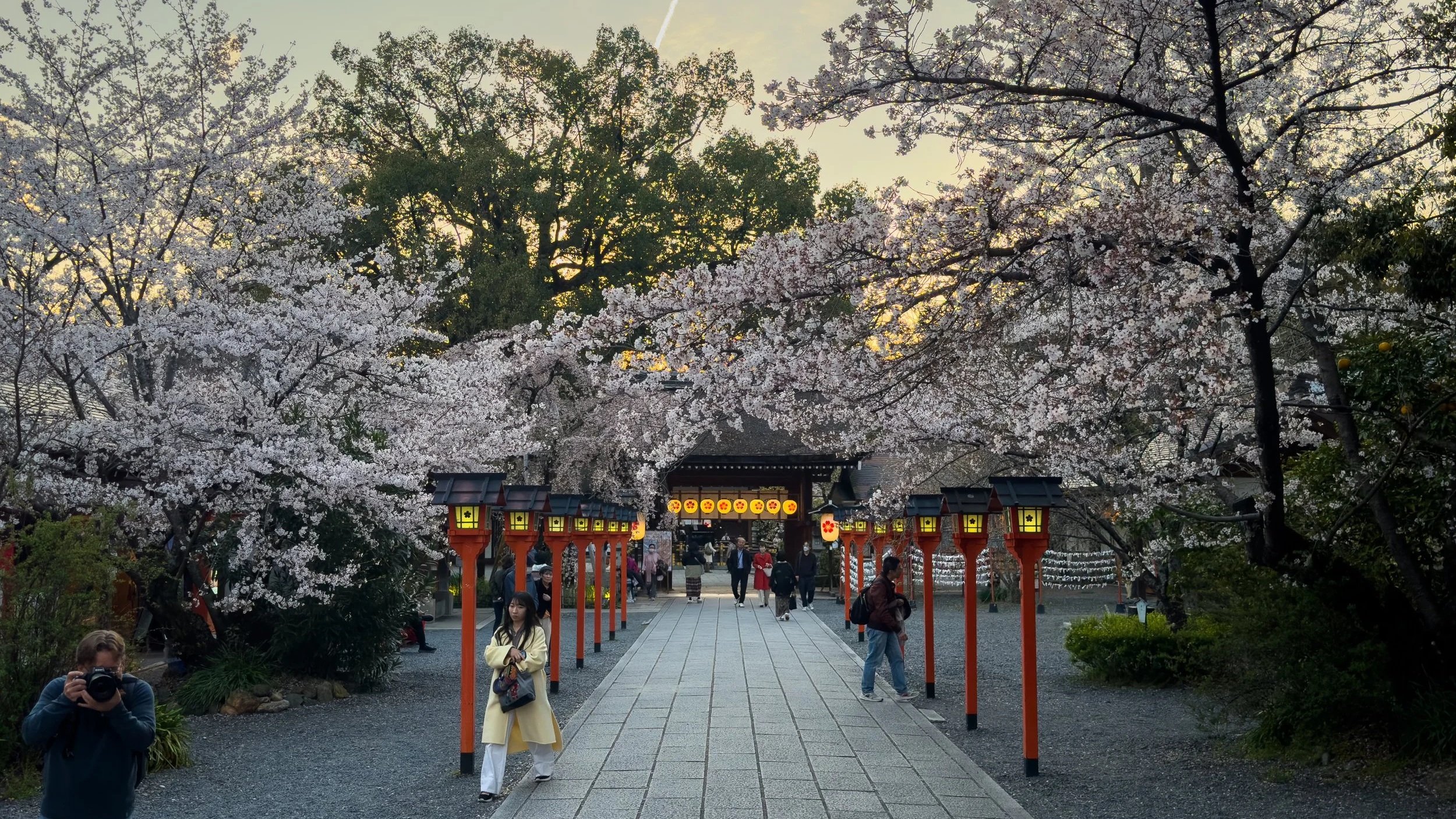
Hirano Shrine – Kyoto, Japan
Probably the most memorable part of my time in Kyoto was learning about the geiko (known as geisha outside Kyoto)—and their apprentices, the maiko. As teenagers, the maiko live for years in boarding houses that sponsor and invest in them while they train to become geiko. Our workshop instructor emphasized that they are not prostitutes, but artists whose role is to entertain guests through traditional dance, music, and tea ceremonies. Everything about their public presentation is carefully choreographed and protected. From their elaborate and traditional kimonos to their perfectly styled hair and flawless makeup. I was fascinated when we visited a traditional tea house and sat down for one of these performances, after which we were lucky to have a sort of Q&A session with our geiko. I sat listening to this obviously bright young woman patiently answer everyone's probing questions: what made you decide to become a geiko? What do you like most about it? I found myself wondering who she had been before. Thinking about it now, I saw something of myself in her. I must have. She chose an entirely different life. And so am I. Maybe I worry for her. Is this who she really is? And then I realized I was wondering the same things about her that, years ago, I might have wondered about myself.
When it was finally my turn, I asked if she ever went home. And she does. On holidays. Even now I struggle to understand why someone would want to choose this life—but I don't have to. Like my choices, hers are her own and to be respected. I have also chosen an unconventional path after years of my own performance, and not even knowing it. She chose hers with open eyes. Can she veer off her chosen path? Yes, but she has to ask for permission to be released from it. I finally realized that I never had to ask for permission, and I spent years believing I did.
Kyoto felt timeless in a way, not because I was there a long time—I wasn't (only four days). Maybe it was because of the sakura that always seemed to be in some sort of state of slow motion—pale pink floating in the air, snowing on pathways, fanning out from under trees on the water. In this photography workshop, much of the focus, the subject matter in Kyoto, was the sakura. It was the season in Japan after all. Unfortunately within a couple of days, I got cherry-blossomed out. For my fellow workshop participants, though, the blossoms never seemed to lose their magic. Watching them photograph blossom after blossom, I began to wonder whether something was wrong with me. Had I already become numb to something so beautiful simply because it no longer surprised me?
But no, nothing is wrong with me. I guess I'm simply hoping to move through this world in a way that allows me to feel the relief of an exhale, find contentment where I am. And again, I come around to that word that I tell myself to focus on a lot these days: presence. Being present enough to see the world around me and feel like it's enough just as it is.
Again I hear the nagging ping of Messenger. And I muse as I get back to clearing out my apartment: I'm selling my wine rack and suddenly I want a cocktail...
Follow my journey on Instagram @odiseabyemmy. For more Japan photography, visit Emmy Photography.