
The Long Goodbye
I write this from a place that feels like home, but not my home—sitting on the lanai of our condo in Kaʻanapali, Maui, overlooking the ocean. The Hawaiian air is warm and heavy with humidity. Palm trees sway in the wind, bringing forth the smell of the sea that calms me. Turtle doves coo nearby. Families play on the beach below, their laughter and squeals of delight carrying upward as clouds drift lazily across a bright blue sky.
As I sit here, I’m reflecting not only on Lima, but also on the six weeks that led me there—Chile, Peru, the reasons I went, and what surfaced at the very end of a journey that felt longer than the others somehow. Not harder. Just deeper. More revealing.
When I arrived in Lima, it was unmistakably an ending. The end of our Machu Picchu tour. The final days with a group that had grown unexpectedly warm and familiar. And, in a quieter way, the end of something larger—a long chapter of building, proving, enduring.
I was tired. Not just physically, but in my bones. I didn’t feel a rush of excitement to explore Lima on my own, though of course I did because that’s who I am. I don’t sit still when I’ve come this far. But I felt done, for now, with doing everything alone. Being part of a group again—even briefly—had stirred a longing I hadn’t fully acknowledged before: to belong, to share, to not always be the one carrying everything solo.
The Last Night
Our final night together in Lima began quietly.
It was still light out when our guide, Mary, led us through the streets—families walking with children in costume swinging their little pumpkin buckets of candy treasures, parents trailing behind, the city easing into Halloween rather than erupting into it. It felt gentle, communal. Ordinary in the best way. Not yet charged with the awareness that this was the end.
When we arrived at Paco Yonque, we didn’t sit down for dinner right away. Instead, we toured their first floor museum dedicated to the history of the Peruvian yonque (a sugar cane distillate), a dimly lit room that felt like a mad scientist’s laboratory. Shelves lined with jars holding 2,500 flavors of yonque made from the most unusual ingredients: spiders, snakes, insects, things meant to cure every imaginable ailment. Mystical, curious, a little absurd. We tasted yonque, laughed, took silly group photos. It was playful and strange and fun—one last moment of lightness before the weight of goodbye arrived.
Upstairs, dinner unfolded slowly. Warm conversation, shared stories, reflections on the week we’d just lived together. And toward the end of the meal, something shifted. One by one, people shared their favorite moments. A few grew emotional, touching everyone with their tenderness. Then we presented Mary with a card and chocolates—something a few members of the group had quietly organized. She cried, too, clearly moved. Watching her, I wondered how many times she experiences this—how many endings she carries with her each year.
After dinner, the city had transformed.
The streets were louder now, brighter. Music, costumes, movement everywhere. Mary led us once more through the celebration, weaving us through the energy of the night, as if giving us one last shared experience to hold onto before we scattered back to our separate lives.
Over the next couple of days, the group dissolved gently. Familiar faces at breakfast. A dinner with one person. A laugh here and there. Until, eventually, it was just me—Mary off to her next tour, everyone else returning home.
The long goodbye had happened quietly, in pieces.
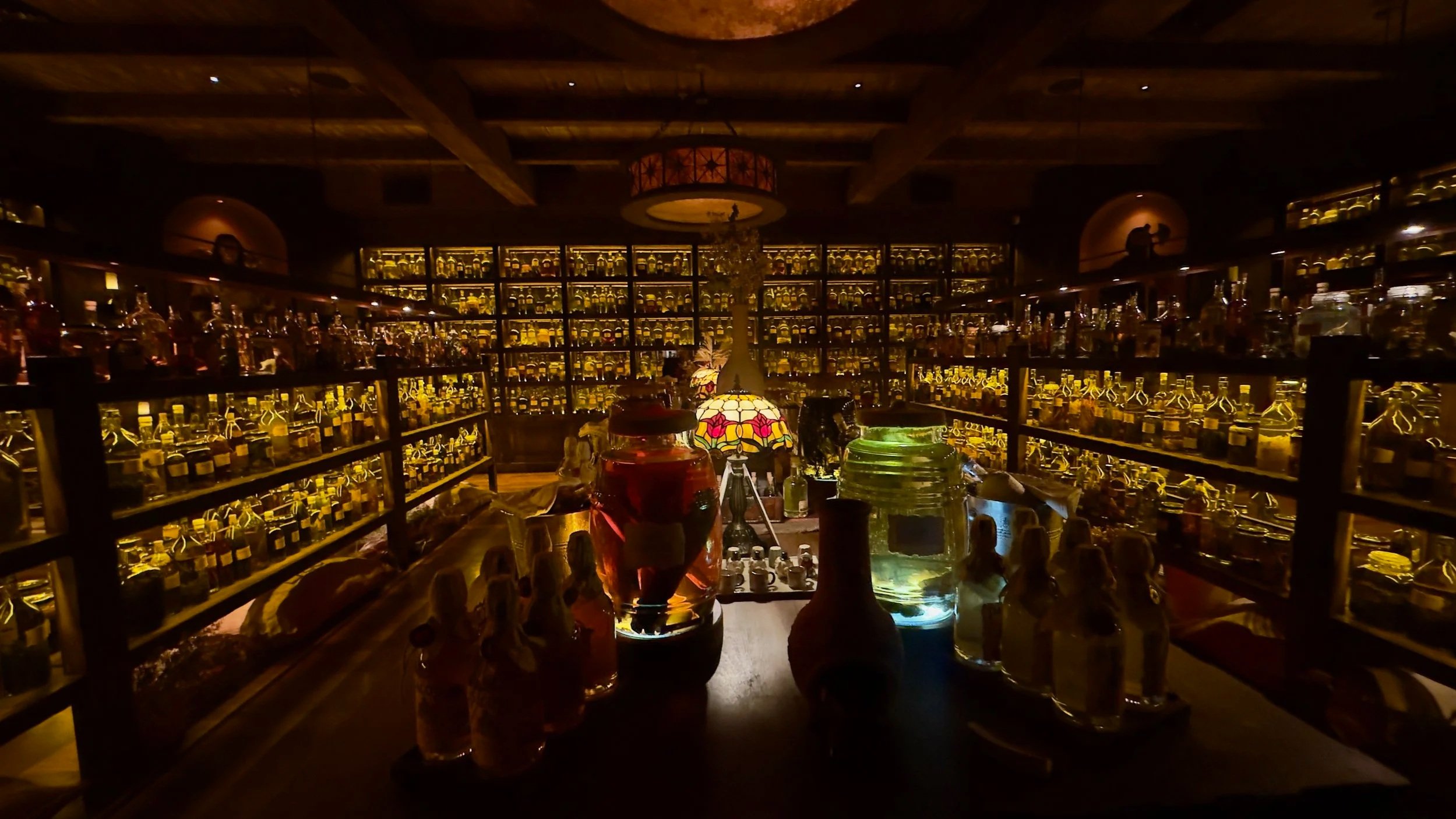
Paco Yonque — Lima, Peru
What Lingered in Lima
Lima surprised me with its warmth and color. Giant murals splashed across buildings. Streets alive with movement and personality. Halloween spilling joyfully into the city—kids in costumes, music, dancing, laughter filling the parks.
In Kennedy Park, cats wandered freely through a sanctuary cared for by the community. Locals, children, visitors—all tending, feeding, watching over them. It felt like a shared act of gentleness. A place of care, for both animals and people who needed something soft to hold onto.
There were signs, too—moments that made me pause. A battered monarch butterfly landed on my shopping bag and stayed with me for blocks, clinging as if I were its shelter. Birds flew in strange, looping formations over the Basilica and catacombs, back and forth, again and again, until I stopped walking just to watch.
I was full—of pisco sours and photographs, of half-formed ideas about what this work could become, of gratitude that I got to live a life like this at all. But I was also tired. Not just travel-tired—creatively tired. Somewhere along the way, the joy of making had been replaced by the pressure to keep producing.
And still—despite the beauty—I felt a distance from Lima. A quiet disconnect. I walked its streets, but my heart felt as though it was already moving on. Maybe I was already leaving. Maybe I had already crossed some invisible threshold.
What Remained
When the group was gone, what surprised me most was how conflicted I felt. I was ready to go home—but not to home. Not to the pressures, expectations, guilt, and noise waiting there.
Home had begun to mean something else entirely.
San Francisco is home because it’s full of the people and rhythms I value—friends, neighbors, my cat, a life I know well. Fremont is home because my parents are there, where my early sense of self began to take shape. And Maui is home because it feels calm and simple, a place where memories soften everything.
And then there are the places—and people—that make you feel at ease in your own skin. Where you don’t perform. Where you feel free, unguarded, present. That feeling had shown me something about the kind of home I want to build going forward. And once I could name that kind of home, I could also see what had been keeping me from moving toward it.
Somewhere in the middle of all that—the exhaustion, the beauty, the gratitude, the doubt—something else became clear. What I was finally ready to release wasn’t a place or a person, but a belief: that I had to have everything figured out before I could move forward.
Stepping Forward
This Chile-Peru journey didn’t convince me to change my life.
That spark was lit earlier—in Spain and Portugal in 2023—and became undeniable a year later, standing by the sea in San Sebastián. By the end of that 2024 trip, I had already gone all in. Odisea was born. The direction was set.
What Chile and Peru offered wasn’t persuasion, but confirmation. A deeper understanding of what this life asks of me—and what I’m ready to release so I can meet it honestly.
I don’t have everything mapped out. I don’t need to. Perfection isn’t the requirement—presence is.
Returning meant finishing things in a grounded way—putting practical pieces in place so I could live differently, not just survive, and allowing my creative work to evolve into something more sustainable and honest.
I hadn’t officially enrolled in the teaching credential that would allow me to work abroad yet. I hadn’t sent the deposit for the next photography chapter I was moving toward. But the direction itself was already clear. Spain wasn’t a question I was debating; it was something I was moving toward, because it made sense emotionally and practically. Staying where I was, living the way I had been, no longer did.
Lima didn’t make that decision for me. It simply confirmed that I was ready to step forward.
It’s time.
Follow my journey on Instagram @odiseabyemmy. For more Peru photography, visit Emmy Photography.