
Breathing
The Release After the Climb
I didn’t expect Cusco to feel the way it did.
By the time we arrived, our little tour group was coming down from the intensity of Machu Picchu—the logistics, the timing, the crowds, the constant movement forward. There was a kind of pressure there I hadn’t anticipated. Breathless, but not in the romantic sense. Restricted. Managed. Always aware of the clock.
And then suddenly, Cusco: Bright. Open. Alive.
It felt like stepping out into fresh air—which is ironic, given Machu Picchu’s misty mountaintop setting. But here, the pressure dissolved. The streets opened up. The energy shifted. Our pace softened. We exhaled.
Cusco didn’t ask us to rush. It welcomed us in.
A City That Lives
What surprised me most was how alive Cusco felt.
Yes, there were tourists—but there were also locals everywhere, going about their daily lives. Life didn’t rush outward here. It opened slowly—through doorways, across courtyards, behind stone walls. Walking the narrow streets, I found myself peeking into restaurants and shops, catching small, warm moments that made the city feel lived-in rather than performed.
You didn’t hear the city shouting. You sensed it breathing.
The light was extraordinary—expressive clouds drifting across blue skies, casting shadows on historic stone walls. Bright doors tucked into narrow streets. Flower pots climbing staircases. Color everywhere.
And threaded through it all: the legacy of the Incas. Their stonework still holding fast, mortarless blocks fitted together so precisely they’ve endured centuries of earthquakes and change. You could see history everywhere, but it didn’t feel distant. It felt integrated. Present.
Cusco wasn’t asking to be admired from a distance. It was inviting us to wander.
The Choice We Had to Make
We only had one full day in Cusco.
That meant a choice: an all-day excursion—Rainbow Mountain, horseback riding, whitewater rafting—or staying in the city itself. I chose to stay. Why rush away from a place that finally felt like we could breathe?
Some of us made different choices, and later we all agreed on the same thing: we could have used one more day. One more day to wander without an agenda. To do both the excursion and the city. To linger.
That constraint lingered with me—the familiar tension of wanting to experience something fully, but having to choose how. Still, the day we had felt rich.
Our guide, Mary, moved us through the city with her warmth and humor—not just through streets but through stories. We visited a local jewelry workshop, where artisans crafted their pieces by hand—and I bought a ring as a small trinket of my trip. And we discovered a new favorite lollipop (a small joy I still think about). We passed through San Pedro Market—a sensory overload in the best way. Locals shopping, vendors calling out, aisles devoted to everything imaginable. Nothing wasted. Nothing polished for show.
Life, in motion. And it felt easy to be there.
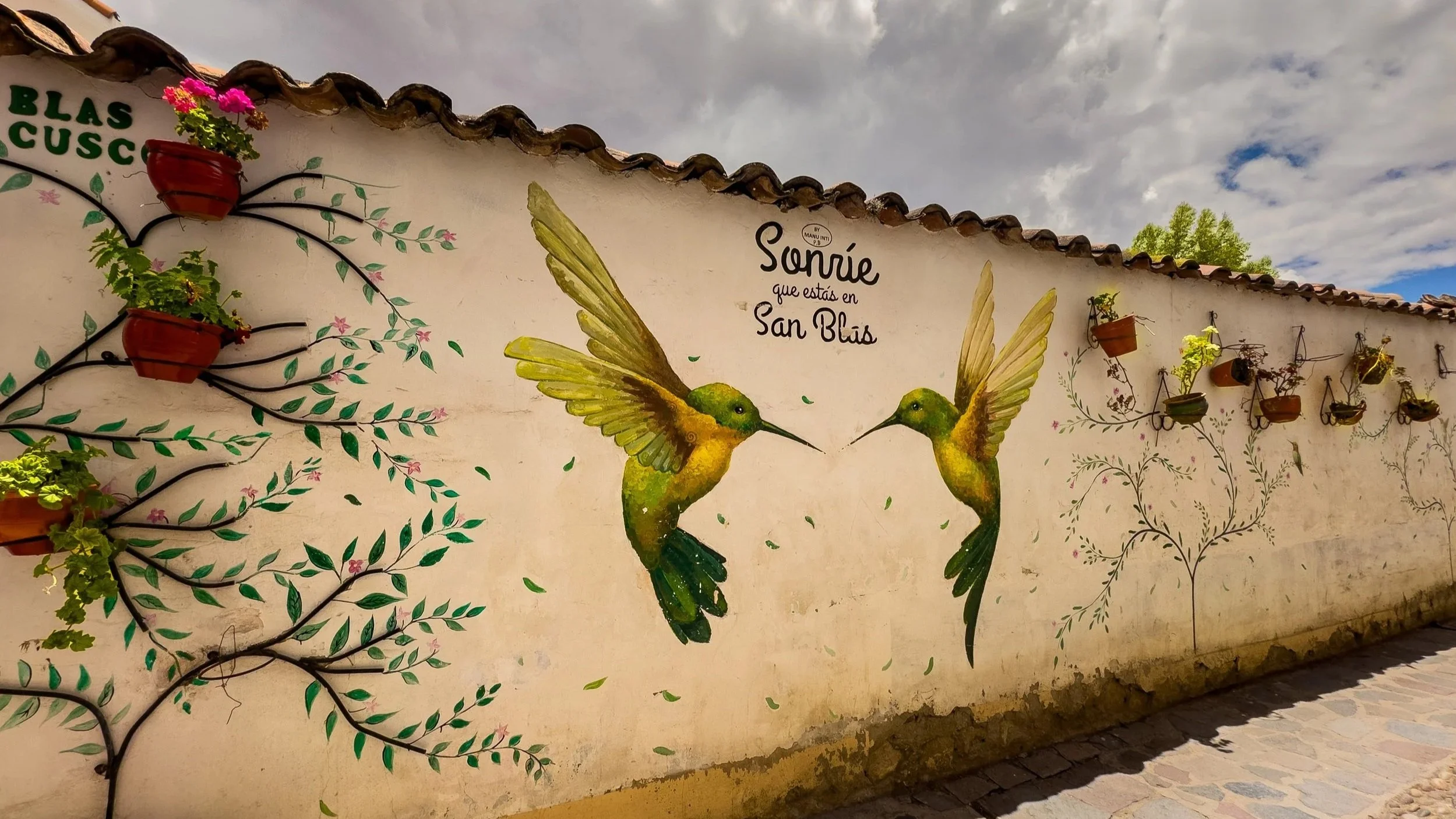
San Blas, Cusco
Where the Journey Softened
Cusco felt like the place where the journey softened.
After the build-up, the pressure, the anticipation—this was where we slowed. Where travel stopped feeling like a performance and started feeling like presence again. Where we weren’t chasing a moment, but inhabiting one.
There was humor here. Ease. Lightness.
Even Halloween followed us—hotel staff dressed up, airline employees in costume, laughter threaded through what could have felt like an ending. Instead, it felt like a gentle release.
Cusco wasn’t louder than Machu Picchu. It didn’t try to impress. It simply was.
Learning When to Linger
Cusco stayed with me because it reminded me of something I keep relearning: that not everything meaningful announces itself loudly. That some places—and phases of life—ask you not to conquer them, but to listen.
We all wished we’d had more time there. One more day to wander without plans. One more morning to maybe start slowly in a small café, coffee in hand, watching the city wake up. One more evening to sit somewhere warm and familiar, laughing with our little group that had become like family, knowing there was nowhere else we had to be.
But maybe that longing is part of the lesson, too.
Cusco was a pause—a release after the constriction, a breath after the climb. It was where the journey softened, where we stopped performing our trip and started inhabiting it again. Where travel felt less like achievement and more like presence.
I don’t remember Cusco as a checklist of sights. I remember color. Light. Movement. The feeling of being unhurried—even briefly.
And I think that’s what I want to carry forward.
Not just in travel, but in how I move through what comes next. A reminder not to rush past what feels alive. Not to assume the most meaningful moments will always be the most famous ones. To linger when something feels warm, human, expansive—even if it doesn’t fit neatly into the plan.
Cusco didn’t ask me to hurry. It asked me to breathe.
And maybe that’s its quiet legacy—teaching me that sometimes the most generous thing you can do for yourself is slow down long enough to notice when you’ve arrived somewhere good.
Follow my journey on Instagram @odiseabyemmy. For more Peru photography, visit Emmy Photography.