
It’s Complicated
Puno, Peru makes Arequipa feel like a major urban city. The drive from Juliaca Airport—about an hour through the dry, cluttered landscape—reminded me of Atacama, Chile at first, but the resemblance faded quickly. Here, the roads felt closer, the air windier, the scene more crowded. Half-finished brick homes leaned into one another, tangled power lines framed the horizon, older cars rumbled and sputtered, and dogs darted between them like they owned the place. And the air—so heavy at night, thick with smoke that lingered long after dusk.
Even though it’s considered a main tourist town, Puno feels raw and unpolished. My hotel key wasn’t electronic but metal, attached to a wooden tag with the room number carved in. Through the bathroom window—which must have opened into some kind of inner shaft—I could hear conversations, laughter, even toilets flushing from neighboring rooms. A reminder that privacy is a luxury of home, not a guarantee of travel.
A Day on the Lake
I had come here for Lake Titicaca, the highest navigable lake in the world at 12,500 feet above sea level. Its floating islands of Uros and the nearby isle of Taquile, known for its steep hillsides and traditional weaving culture, had been described as must-sees—windows into a traditional way of life. I wasn’t sure what to expect, but I was open.
It couldn’t have been a more beautiful morning to be on the water—bright sun, blue skies, and the glassy shimmer of the lake stretching endlessly in every direction. Our small group boarded one of many boats heading out, each nearly identical, each filled with travelers chasing the same experience. The air buzzed with a kind of cheerful confusion as guides shouted names, engines revved, and boats jostled for space.
As we finally pulled away from the harbor, I felt that familiar thrill of movement—of being carried somewhere new—but also a quiet curiosity about what we’d really see. The guide had promised glimpses of a way of life preserved through centuries. I wondered if that was still true.
The Floating Islands of Uros
We visited two of the roughly ninety floating islands that make up Uros, home to the indigenous Uru people. Until I arrived, I hadn’t really understood what made these islands float—dense blocks of totora reeds and their roots, naturally buoyant and replenished regularly as the lower layers decompose. The “mayor,” as our guide called him, demonstrated the process alongside another community member, while his wife and mother looked on. The reeds, they explained, are not only the foundation of their islands and homes, but also serve as a food source—peeled and eaten raw, tasting a bit like celery.
As we stepped off the boat, the ground beneath our feet gave slightly, springy and damp, squishing softly with each step. It was remarkable, really—an entire world built on something that could, at any moment, drift or sink without care and maintenance. But what began as fascination slowly shifted to discomfort. Each family member took turns presenting something—an explanation, a craft, a smile—followed by the guide prompting us to clap. Again and again. And somewhere in that repetition, the whole thing began to feel worn and rehearsed, like we were watching a performance rather than genuinely learning about their history and way of life.
Then came the visit to the mayor’s mother’s hut—bare, almost stark. A thin blanket tossed across the bed, no signs of personal items, just a few things scattered in the corners. It didn’t look lived in, at least not comfortably. And when we were invited to take a short ride in their traditional reed boat, it was attached to a small motorized canoe that tugged us along—another layer of illusion. The children who, we were told, used these boats to get to school were nowhere to be seen—even on the second Uros island we visited.
Was this truly their home, or a setup for tourists? Are these still their traditions, or simply the ones that sell best?
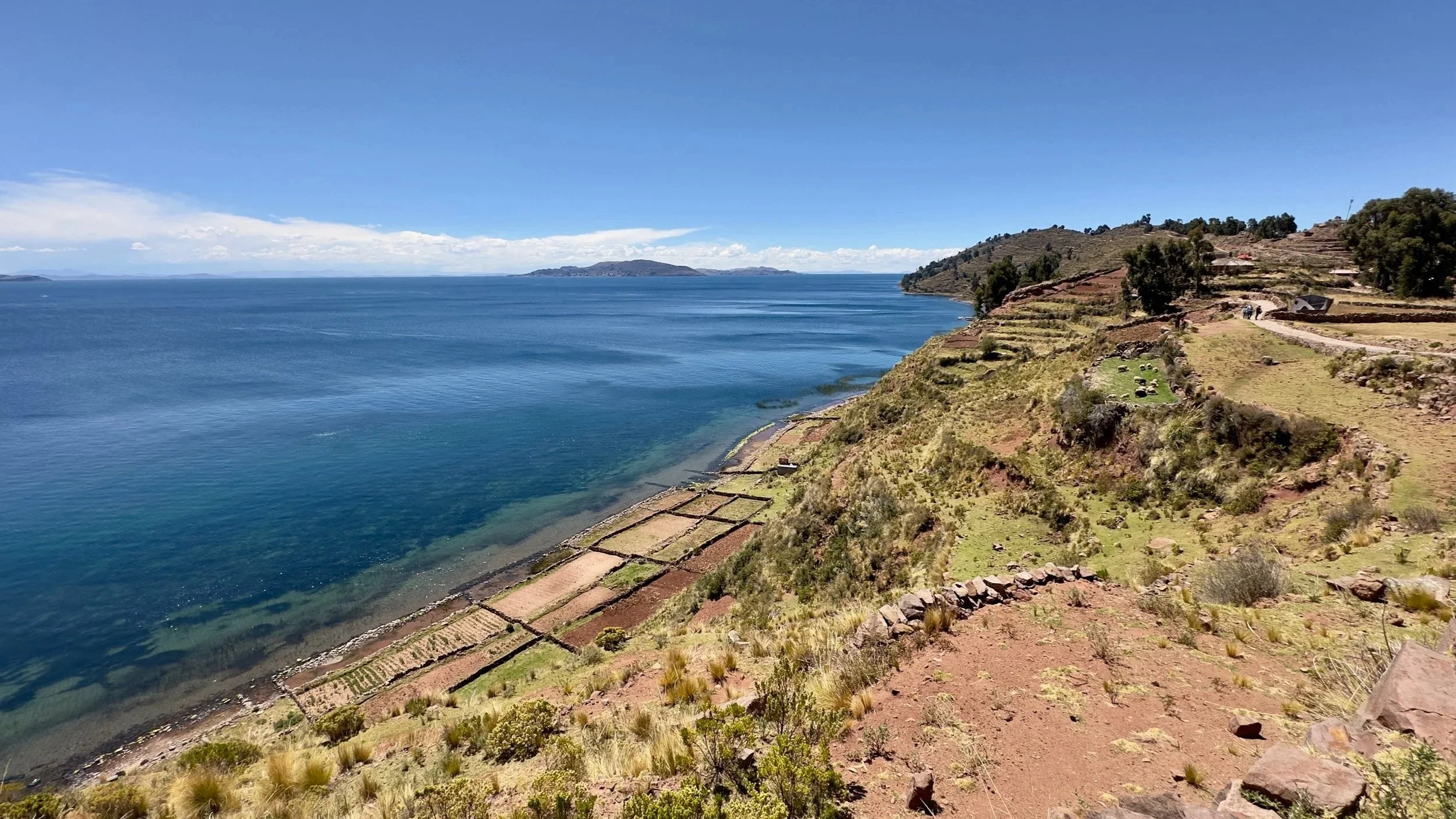
The island of Taquile on Lake Titicaca, Peru
Lunch on Taquile
Taquile, the next stop, offered its own version of the same unease. The island itself was beautiful—rocky paths, terraced hillsides, endless views of the lake—but at every bend sat women behind blankets spread with souvenirs. And not all of them seemed handmade. Keychains, magnets, stuffed alpacas—all things that could’ve come from a market anywhere. After a dance presentation and a short demonstration of the plant used to make their shampoo, we were guided to a “textile market,” where tables overflowed with crafts for purchase. The rhythm was the same: smile, present, clap. Over and over.
Lunch came last—a simple, traditional Taquile meal served indoors, overlooking the lake. By then, our boat group had spent nearly the entire day together. We’d smiled, snapped photos of each other, clapped side by side. I expected at least some easy conversation to carry into lunch. Instead, it quietly shifted.
The groups around me—now familiar faces—talked easily among themselves, slipping into their shared languages. I tried a few times to join in—a smile here, a question there, even stumbling through Spanish—but the conversations never opened. They simply went on without me.
My nature has always been to take the hint. If someone ignores or excludes me, I assume they’re not interested—in me, or in whatever bridge I’m trying to build—and I move on, even if it stings a little. But here, on this island in the middle of a vast lake, there was nowhere else to go. I sat surrounded by chatter I couldn’t enter, and something in me let go. Maybe connection isn’t something to chase. Maybe it’s something that happens when the space is mutual.
And maybe that’s the quiet gift in moments like these—the reminder to notice who’s sitting alone, who’s trying to find their way in, and to make the effort I wished someone had made for me.
Reflections on Connection
On the boat ride back, listening to the mix of voices and laughter around me, I thought about how complicated it all was—travel, culture, human connection. We come searching for meaning, for truth, for stories that move us. But sometimes what we find instead are our own quiet insecurities mirrored back to us.
Maybe that’s the thing about travel—it doesn’t just reveal the world, it reveals you in it. The places where you still want to belong. The questions you’re still learning to ask. The discomfort that reminds you you’re alive, awake, still learning.
Follow my journey on Instagram @odiseabyemmy. For more photography, visit Emmy Photography.