
Who Are You
Sitting here in Ishigaki, I can’t help but chuckle when I think back on Osaka. The two couldn’t feel more different, especially after the quiet simplicity of Taketomi, a small island just off Ishigaki where I had spent a night.
Osaka wasn’t simple. It was noise, movement, food everywhere you turned. Takoyaki—octopus balls? Sure. Ramen? Okee doke. Deep fried (kushikatsu) or grilled (yakitori) skewers? Why not both? There was always something to try, always something just within reach, and never quite enough time to try it all.
But that version of Osaka mostly lived in Dotonbori and around Ebisuhashi. At night, it felt like a kind of organized chaos, with neon signs stacked high into the sky, crowds pressing through intersections that rivaled Tokyo's Shibuya Crossing, and a river cutting through the middle of it all. It was loud, a little overwhelming, and full of energy. And somehow, it was wonderful.
Move just a little further away, though, and Osaka shifted. It got quieter. More local. More lived-in. That’s where our Airbnb was, tucked into a neighborhood where daily life carried on at its own pace.
That pace had a rhythm. Bicycles were everywhere. They weren’t just passing by, they were the main mode of transportation. As a tourist, you were constantly adjusting, stepping aside, second-guessing which side to walk on, wondering if your group of five should collapse into single file. Osaka demanded your attention in that way, even as it tempted you to look elsewhere—into shop windows, at trays of hyper-realistic fake food on display, at vending machines offering both hot and cold drinks. A hot café au lait in a can? Sure. Why not.
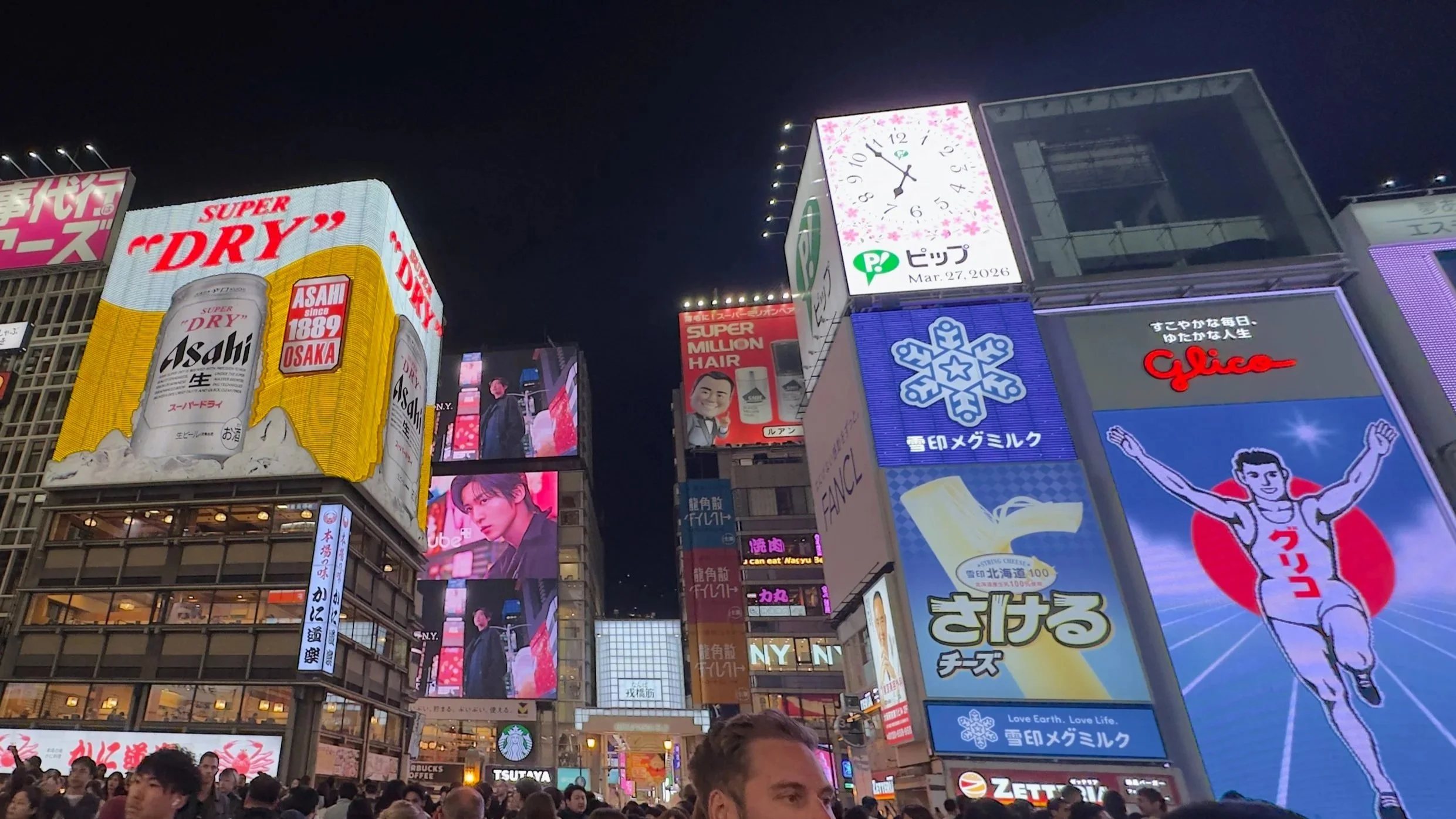
Dotonbori – Osaka, Japan
Osaka kept pulling you in different directions at once.
It’s also where my mother was born. I thought I might feel some kind of connection because of that, a sense of familiarity, maybe even belonging. But I didn’t.
Part of that might be practical. I couldn’t go stand in the place where she was born. The U.S. Army hospital from that time no longer exists, and it’s hard to say exactly where it once stood—likely somewhere on or near the grounds of Osaka Castle. And she didn’t really live in Osaka anyway, not in the way that matters. That was Kobe, where she spent her early years, a place I wasn’t going to visit on this trip.
But still, I thought I might feel something.
And I didn’t.
In fact, if I’m honest, I’m not sure I ever quite figured Osaka out. So maybe the better question is—who was I there?
I was with friends, which is not how I usually travel these days. And that alone changed everything.
There are so many small moments I think back on now and laugh. Our shared obsession with 7-Eleven and FamilyMart. The cream puff I swore existed—the perfect one I had in Kanazawa, filled with whipped cream, that I kept trying to find again for them (they’re still not convinced I didn’t make it up). We tried every gummy we could get our hands on, and there are a lot of gummies in Japan.
We developed a fondness for the Japanese whisky highball, joking that we’d return to the U.S. asking for a Tito’s highball instead of a vodka soda, still unclear why the term seems reserved for whisky in Japan.
Between the three of us, we somehow ended up with an unreasonable number of sneakers—Onitsuka Tiger, Hoka, Salomon. I tried to join in with Onitsuka Tiger, but they didn’t have my size, so I contributed elsewhere.
Conveyor belt sushi after a fancy sake tasting. Wandering through Doguyasuji Arcade—Osaka’s Kitchen—surrounded by knives and cookware and everything you didn’t know you needed until you saw it.
It was chaotic, indulgent, and a little ridiculous.
And it was fun.
But even in all of that, there were quieter moments that stayed with me more.
Our adopted breakfast spot, where we discovered the set menu: thick toast, a hard-boiled egg, and café au lait. Simple, repetitive, perfect. A small neighborhood café called Lucky & Love, run by a man who seemed endlessly amused that we were from San Francisco, calling it out to his regulars every time we walked in. The space filled with mismatched decorations, including the Seven Dwarves greeting you at the door, and regulars who sat smoking inside, looking like they had been doing so for decades and somehow still going strong.
We were welcomed there. Easily. Naturally.
The same way, I realized, I had been welcomed everywhere in Japan.
So maybe Osaka isn’t something I needed to define. Maybe it’s a place that exists in layers, loud and quiet, chaotic and ordinary, overwhelming and easy, all at once.
And maybe being there wasn’t about understanding it.
Maybe it was just about moving through it—with friends, with curiosity, with an openness to whatever it happened to be in that moment.
Eating, wandering, laughing, dodging bicycles.
Taking it all in.
And letting that be enough.
For more Japan photography, visit Emmy Photography.